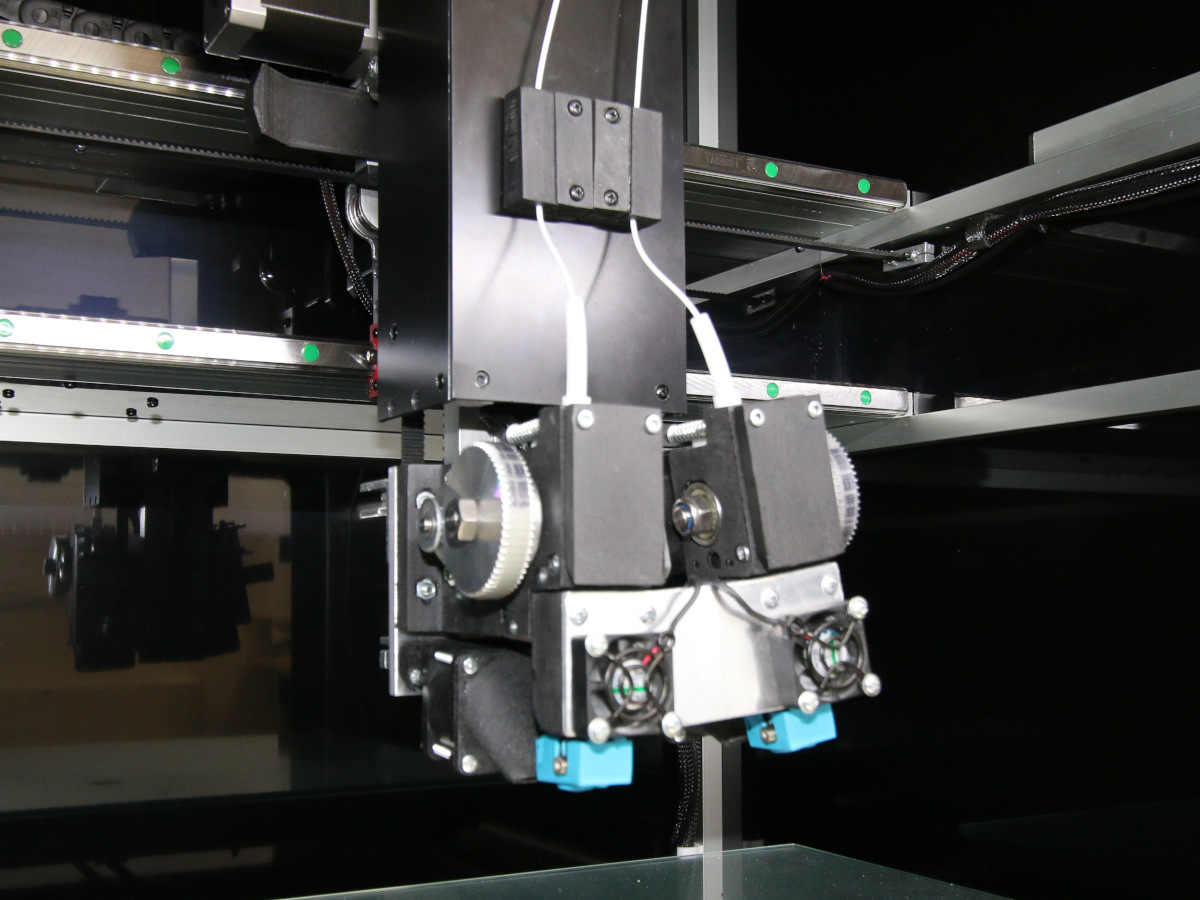
Large-format professional 3D printers have become an increasingly important tool for companies that need to produce prototypes, models, technical components, and parts in large volumes. The development of large-format additive manufacturing now allows the creation of objects that, due to their size, would be difficult to produce with a conventional 3D printer.
In the industrial sector, however, size isn’t the only important factor. A large-format machine must also guarantee precision, productivity, and reliability : three essential characteristics for achieving consistent results and reducing production times. When these characteristics are combined with suitable materials and proper digital model preparation, 3D printing can become a strategic part of the production process.
The ability to go directly from a CAD design to a physical component also eliminates some intermediate steps and facilitates the creation of functional prototypes. This gives designers and engineers greater freedom to test, modify, and validate their designs before launching final production.
The importance of precision in large-format 3D printing
When working with small components, a slight dimensional deviation may be insignificant. However, with a large component, even small variations can affect the final result. For this reason, dimensional accuracy is one of the aspects to consider when choosing a professional 3D printer.
Accuracy depends on several elements of the production system. Structural stability, axis movement, extrusion system, temperature control, and material characteristics all influence the ability to produce parts with uniform dimensions.
It’s also crucial to consider the object’s orientation and layer distribution. Proper planning can reduce some warping issues and improve the component’s stability during production.
In a large-format professional 3D printer , therefore, precision shouldn’t be understood solely as the ability to reproduce small details. It also involves maintaining a stable and reproducible geometry across the entire surface of a large part.
Productivity: producing more in less time
Productivity is another key factor for industrial applications. A large-format machine allows the production of large components without the need to split them into numerous parts .
This option can reduce the number of subsequent operations and simplify the assembly process. Depending on the project, a component can be produced directly in a single process or divided into modules specifically designed for ease of assembly.
Productivity is also related to printing speed. However, simply increasing speed doesn’t always translate into better output. A balance must be found between speed, quality, and process stability .
Excessive printing speed can compromise surface quality or the accuracy of certain geometries. A properly optimized configuration allows you to achieve an adequate level of productivity without compromising the required component characteristics.
What are the advantages of a large-format professional 3D printer?
Using a large-format additive manufacturing system can bring several benefits to a company, especially when custom prototypes and components are needed.
Key benefits include:
- Production of large components .
- Reduction in the number of components to be assembled.
- Greater freedom in developing complex geometries .
- Reduction of time between design and prototype construction.
- Possibility of creating unique pieces and small series.
- Use of different technical materials .
- Greater flexibility in modifying projects.
- Optimization of material consumption through internal structures.
- Ability to produce tools, models and functional models.
- Reduction of some operations required in traditional processes.
These advantages make professional 3D printing suitable for numerous applications related to engineering, industrial design, manufacturing and product development.
Reliability for continuous industrial processes
A 3D printer intended for a professional environment must offer a high level of reliability . In an industrial application, a process interruption can result in wasted time and materials, especially when dealing with components that require many hours of production.
Reliability is linked to the mechanical stability of the machine, the quality of its components, the control of printing parameters and the ability to maintain constant conditions throughout the entire process.
This aspect becomes even more important when producing large components. A production process that lasts many hours must maintain sufficiently stable conditions to prevent small problems from compromising the entire component.
For this reason, repeatability is a particularly important feature. It’s not enough to produce a part correctly just once; a professional system must deliver consistent results when a given process is repeated.
The role of thermal control
In additive manufacturing with thermoplastics, temperature control can have a significant influence on the outcome.
During printing, the material passes through various thermal states and is deposited layer by layer. Temperature variations can promote certain phenomena such as shrinkage or warping, especially when producing large parts.
For this reason, professional large-format solutions must pay particular attention to the thermal management of the production area and the working conditions of the material.
Proper temperature management helps improve dimensional stability and can facilitate the production of large components.
Materials for professional applications
The ability to use different materials considerably expands the applications of an industrial 3D printer .
Thermoplastic materials can be selected based on the characteristics required for the finished part. For some models, conventional materials may be sufficient, while for technical applications, formulations designed to offer greater strength, stiffness, or thermal stability may be more appropriate.
There are also composite materials , in which fibers are embedded in a polymer matrix. These solutions can be used to achieve specific combinations of lightness, stiffness, and strength.
The choice of material must always be made taking into account the final use of the component and the conditions to which it will be subjected.
Optimized design for large sizes
The quality of a printed part doesn’t depend solely on the machine. CAD design plays a fundamental role.
Before starting large-scale production, it’s a good idea to analyze the geometry to identify any potential areas of difficulty. The designer can adjust the thicknesses, add reinforcement elements, create internal structures, or divide the model into different parts.
Designing for additive manufacturing also enables the use of features that would be difficult to achieve with some conventional methods.
A properly optimized geometry can help reduce the weight of the component , decrease material consumption and improve production times.
Production of a complete piece or modules
One of the main advantages of a large format machine is the ability to produce components that previously had to be divided into numerous sections.
When size allows, producing a complete component can reduce assembly operations and joint areas. This is particularly advantageous for certain prototypes and models produced in high volumes.
However, modular manufacturing remains a very useful solution when the component exceeds the available volume or when transportation and handling require smaller parts.
In these cases, the joints can be integrated directly into the digital design , allowing for subsequent precise assembly of the different sections.
3D printing and large-format additive manufacturing
In the field of professional large-format 3D printing , 3DPRN is linked to the development of solutions intended for large-format additive manufacturing.
To choose the most suitable solution of this type, it’s essential to analyze the specific needs of the project. Production volume, materials to be used, required precision, speed, and level of automation are some of the factors to consider.
A professional solution must guarantee a balance between production capacity, precision and reliability , ensuring that an increase in size does not necessarily imply a loss of quality.
Applications of large-format professional 3D printers
The applications of these technologies are constantly expanding. A large-format 3D printer can be used to create prototypes to verify shapes and dimensions, but also to produce functional components and tools.
Common applications include:
- Large-scale industrial prototypes .
- Templates for design studios.
- Custom components.
- Models and production tools.
- Molds and models.
- Technical models.
- Elements for assembly processes.
- Pieces intended for small series.
- Components with complex geometries.
- Functional models for testing and validation.
The versatility of the technology allows the process to be adapted to different needs without always having to resort to a single production methodology.
Reduce costs by increasing productivity.
In addition to saving time, large-format additive manufacturing can help optimize the overall costs of a project.
The ability to produce directly from a digital file reduces the need for certain intermediate tools and processes. It also facilitates the production of small quantities without requiring specific investments for large volumes.
Another important aspect is the ability to quickly modify the design. If a problem is detected during the validation phase, the CAD file can be corrected and used for the new production.
In this way, 3D printing can help reduce the costs associated with different prototyping iterations .
Large-format professional 3D printers represent an increasingly important solution for the production of prototypes, models, and industrial components. Their true value lies not only in their ability to produce large objects, but also in their combination of precision, productivity, and reliability .
Appropriately configured large-format technology allows for the production of bulky components, the use of diverse materials, and the process can be adapted to custom designs. At the same time, integration with CAD design tools facilitates model modification and accelerates the various development phases.
Choosing a professional solution requires evaluating print volume, compatible materials, accuracy, speed, thermal stability, and repeatability . All of these factors contribute to determining the system’s actual efficiency.
In an industrial context increasingly oriented towards customization and reduced development times, large-format 3D printing offers a particularly attractive combination of flexibility and production capacity. Therefore, these technologies can play an increasingly important role in prototyping, manufacturing, and large-scale product development .


